Frequently asked questions

PumpDaily FAQ

Fast answers about pumps, pressure, flow, controls, cavitation, solar pumping, fire pumps, troubleshooting, and what PumpDaily can and cannot do.

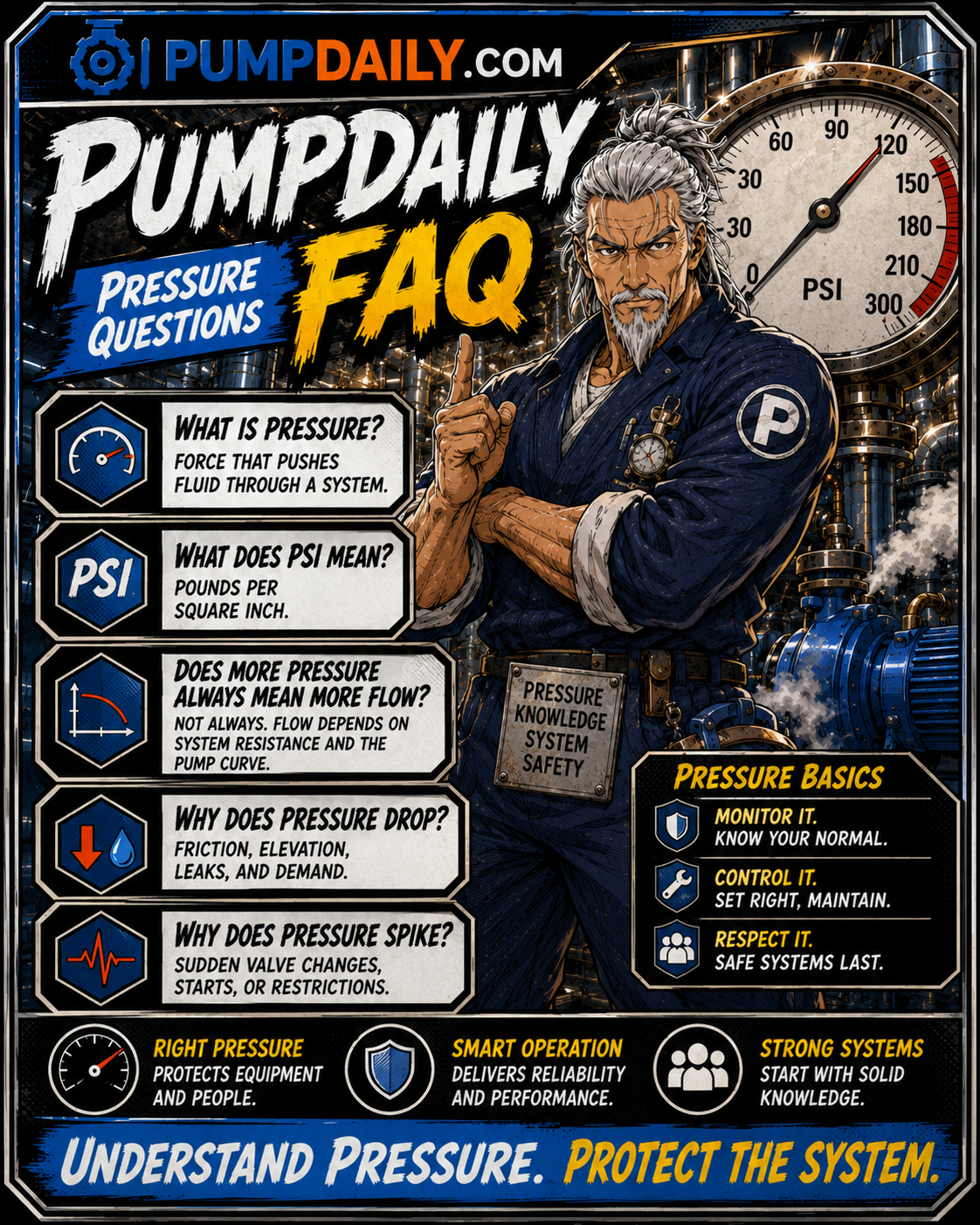
PumpDaily FAQ image with pressure questions, gauges, and pump-room notes

Read this first

PumpDaily gives plain-English education, not site-specific engineering.

The answers below explain pump concepts. Real systems can involve electricity, pressure, flooding, potable water, wastewater, fire protection, confined spaces, and code-regulated work.

For urgent, dangerous, code-regulated, or high-value systems, use qualified professionals.
Pump basics

Pump basics

What is a pump?

A pump is a machine that adds energy to liquid so it can move through a system. It does not create water; it helps available water overcome distance, elevation, pressure, friction, and restrictions.

What is the difference between pressure and flow?

Pressure is force in the system, often measured in PSI. Flow is the amount of water moving over time, often measured in GPM.

Does a higher pressure reading always mean better performance?

No. A valve restriction can raise pressure while reducing useful flow. Always ask where the gauge is located and whether the destination is actually getting enough water.

What is a pump curve?

A pump curve is a manufacturer chart showing how a pump performs at different flow and head conditions.

Common problems

Common problems

Why is my pump noisy?

Noise can come from cavitation, air in the suction line, worn bearings, debris, vibration, loose piping, motor issues, or operation outside the intended range.

What is cavitation?

Cavitation happens when vapor bubbles form and collapse inside the pump. It can cause gravel-like noise, vibration, pitting, and equipment damage.

Why does a pump lose prime?

Common causes include suction-side air leaks, a bad foot valve or check valve, low source water, poor suction piping, or improper startup conditions.

Why does a pump short-cycle?

Short cycling can be caused by a bad pressure tank, wrong pressure settings, leaks, failed controls, poor sizing, or a demand pattern the system was not designed for.

Pump types

Pump types

What is a centrifugal pump?

A common pump type that uses a spinning impeller to add energy to water. Many pool, irrigation, booster, and circulation pumps are centrifugal.

What is a submersible pump?

A pump designed to operate while submerged. Submersible pumps are common in wells, sumps, drainage, fountains, and dewatering systems.

What is a booster pump?

A pump used to raise usable pressure when the existing water pressure is not enough for the job.

What is a sump pump?

A pump that removes unwanted water from a basin, pit, basement, or low area, usually controlled by a float switch.

Solar and fire pumps

Solar and fire pumps

Can solar power run a pump?

Yes, but design starts with water demand, head, flow, storage, controls, and sunlight availability. Panel wattage alone is not a pump design.

Do solar pump systems need batteries?

Not always. If water can be stored in a tank, the tank may be the simplest storage method. Batteries help when pumping must continue without sun, but add complexity.

What is a fire pump?

A code-regulated life-safety pump used to support fire protection water delivery when the normal supply needs pressure or flow assistance.

Can PumpDaily teach me how to repair a fire pump?

No. PumpDaily explains concepts only. Fire pump design, service, inspection, testing, and repair belong to qualified fire protection professionals.

Controls and valves

Controls and valves

What does a float switch do?

A float switch starts or stops a pump based on water level. It is common in sump, tank, and basin systems.

What does a pressure switch do?

A pressure switch starts or stops a pump based on system pressure, often used with pressure tanks in well or booster systems.

What does a check valve do?

A check valve allows flow in one direction and helps prevent reverse flow.

Can a bad check valve cause pump problems?

Yes. It can allow water to drain backward, refill a pit, lose prime, create cycling, or contribute to confusing symptoms.

Safety and contact

Safety and contact

Is PumpDaily engineering advice?

No. PumpDaily is educational content only. It is not engineering, plumbing, electrical, fire-code, water-quality, legal, or safety advice.

What should I do in an emergency?

For active flooding, fire protection alarms, electrical hazards, sewage backup, or life-safety issues, contact emergency services, property management, qualified trades, or the authority having jurisdiction.

How do I contact PumpDaily?

PumpDaily contact is through ABC Solar Incorporated: [email protected] or +1-310-373-3169. There is no web form.

Who brings PumpDaily to readers?

PumpDaily is brought to you by ABC Solar Incorporated, California CCL #914346.

Keep learning

Popular PumpDaily pages

Contact: ABC Solar Incorporated — [email protected]+1-310-373-3169 — California CCL #914346.