Pump reference

Pump Glossary

A plain-English glossary for pump rooms, wells, basements, pools, irrigation fields, fire pump rooms, and anyone trying to tell PSI from GPM without summoning the Cavitation Goblin.

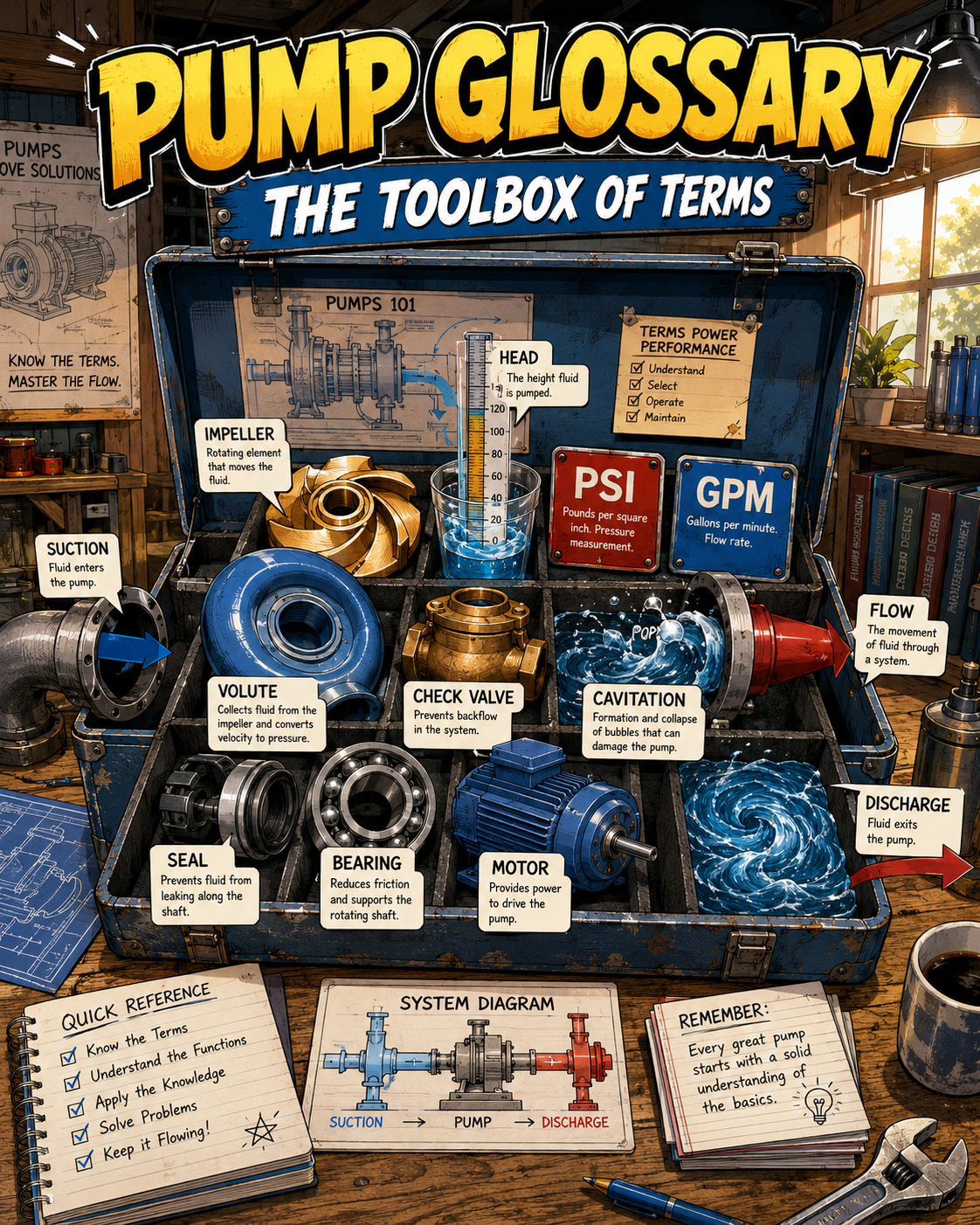
Pump glossary toolbox with manga-style pump terms and labels

How to use this glossary

Use these terms to diagnose the system, not just name the parts.

Pump words are practical. “Pressure,” “flow,” “suction,” “discharge,” “curve,” and “cavitation” are not vocabulary decorations. They point to real operating conditions.

When a pump misbehaves, the right word can keep you from replacing the wrong part.

The PumpDaily rule: define the term, then ask what it means in the actual system.
Pump parts

Pump parts

Pump

A machine that adds energy to liquid so it can move through a system.

Motor

The power source that turns the pump shaft or drive mechanism.

Impeller

A rotating part that gives water velocity and energy in many centrifugal pumps.

Casing

The pump body that guides liquid from the impeller toward the discharge outlet.

Volute

A spiral-shaped casing area that helps convert velocity into useful pressure.

Shaft

The rotating part that transfers motion from the motor to the pump.

Seal

A component that helps keep water from leaking where the shaft passes through the pump.

Bearing

A support component that helps rotating parts move smoothly.

System terms

System terms

Suction side

The inlet side where water enters the pump.

Discharge side

The outlet side where water leaves the pump.

Static head

Height-related pressure requirement before friction and other losses are added.

Total dynamic head

The full head requirement including lift, pressure, friction, fittings, valves, and equipment.

Friction loss

Pressure or head lost as water moves through pipe, fittings, valves, filters, and equipment.

Prime

The condition of the pump and suction line being filled properly so pumping can begin.

NPSH

Net positive suction head; a suction-side concept tied to avoiding vapor bubbles and cavitation.

Duty point

The target operating condition: the desired flow at the required head or pressure.

Pressure and flow

Pressure and flow

Pressure

Force in the system, often measured in PSI.

Flow

The amount of liquid moving over time, often measured in GPM.

PSI

Pounds per square inch; a common pressure unit.

GPM

Gallons per minute; a common flow unit.

Pump curve

A manufacturer chart showing pump performance at different flow and head conditions.

System curve

A representation of the resistance the piping system creates at different flow rates.

Operating point

Where the pump curve and system curve meet in actual operation.

Deadhead

A condition where a pump runs against a closed or blocked discharge with little or no flow.

Controls and protection

Controls and protection

Float switch

A level switch that starts or stops a pump as water rises or falls.

Pressure switch

A switch that starts or stops a pump based on system pressure.

Controller

A device or panel that manages pump operation and protection.

VFD

Variable frequency drive; a controller that can adjust motor speed.

Dry-run protection

A protection strategy to stop or prevent pump operation without adequate water.

Check valve

A valve that allows flow one way and helps prevent reverse flow.

Relief valve

A valve used to relieve pressure under certain conditions.

Alarm

A signal that warns of high water, low pressure, controller fault, or another abnormal condition.

Problems and symptoms

Problems and symptoms

Cavitation

Vapor bubbles form and collapse inside the pump, causing noise, vibration, and damage risk.

Air leak

Air entering the suction side, reducing performance and confusing diagnosis.

Short cycling

Rapid pump starts and stops, often caused by control, tank, leak, or sizing problems.

Water hammer

A shock or banging event caused by sudden changes in water velocity.

Clogged strainer

A blocked screen or basket that can starve the pump.

Low flow

Not enough water moving through the system.

Low pressure

Not enough force available at the point where pressure is needed.

Overheating

Excess heat caused by poor flow, deadhead conditions, motor problems, or improper operation.

Pump families

Pump families

Centrifugal pump

A common pump type that uses a spinning impeller to move water.

Submersible pump

A pump designed to operate while submerged in water or liquid.

Booster pump

A pump used to raise usable pressure in a system.

Well pump

A pump used to move groundwater from a well.

Sump pump

A pump used to remove unwanted water from a basin or low area.

Pool pump

A pump used to circulate pool water through filters and equipment.

Irrigation pump

A pump used to deliver water to sprinklers, emitters, fields, tanks, or zones.

Fire pump

A code-regulated life-safety pump used to support fire protection systems.

Keep learning

Related PumpDaily guides

Safety note: Pump systems may involve electricity, pressure, potable water, wastewater, fire protection, flooding, confined spaces, and code requirements. PumpDaily is educational only.